Business Process Model and Notation (BPMN) is a standardized graphical representation for specifying business processes within a business process model. It was originally developed by the Business Process Management Initiative (BPMI) and has been maintained by the Object Management Group (OMG) since their merger in 2005. The latest version, BPMNRead More →

Introduction ArchiMate is a powerful enterprise architecture modeling language that provides a standardized way to describe, analyze, and visualize the relationships among architecture domains in an unambiguous manner. This case study will use the provided ArchiMate diagram to explain key concepts, including layers, aspects, and relationships within the ArchiMate framework.Read More →

ArchiMate is a powerful enterprise architecture modeling language that helps organizations describe, analyze, and visualize their architectures. One of the key aspects of ArchiMate is its ability to define various types of relationships between different elements within the architecture. These relationships help in understanding how different components interact and dependRead More →

Introduction to ArchiMate Viewpoints The viewpoint mechanism in ArchiMate is a structured approach for creating tailored views of the enterprise architecture for different stakeholders and their specific concerns. This mechanism recognizes that presenting the entire architecture description at once is impractical and overwhelming for stakeholders who are only interested inRead More →

UML (Unified Modeling Language): Primary Focus: Software engineering and system modeling. Strengths: Excels at representing the structural and behavioral aspects of software systems, focusing on class diagrams, interactions, state machines, and other software-specific concepts1. ArchiMate: Primary Focus: Enterprise architecture. Strengths: Provides a broader perspective, encompassing not only software systems but also business processes, organizationalRead More →

ArchiMate is a robust enterprise architecture modeling language designed to support the description, analysis, and visualization of architectures within and across business domains. It is an open and independent standard hosted by The Open Group, fully aligned with the TOGAF® framework. ArchiMate structures enterprise architecture modeling through layering, aspects, andRead More →

ArchiMate, introduced by The Open Group, is an international, vendor-independent standard framework that provides a precise and structured approach to enterprise architecture. Unlike traditional ‘fuzzy pictures’ often associated with architecture, ArchiMate offers a lean and simple language with just enough concepts to model enterprise architecture effectively, without being overly complex.Read More →

Understanding ArchiMate: A Learn-by-Example Guide

ArchiMate is a powerful modeling language used for enterprise architecture. It provides a standardized way to describe, analyze, and visualize the relationships among business processes, organizational structures, information flows, technical infrastructure, and the motivations and goals that drive an enterprise. In this article, we’ll explore ArchiMate using a learn-by-example approach,Read More →

Understanding ArchiMate Transition Architectures

Introduction to ArchiMate Transition Architectures ArchiMate is a widely-used enterprise architecture modeling language that provides a standardized way to describe, analyze, and visualize the relationships among business domains in an enterprise. One of the key aspects of ArchiMate is its ability to model transition architectures, which are essential for managingRead More →

Understanding the Motivation Viewpoint in Enterprise Architecture

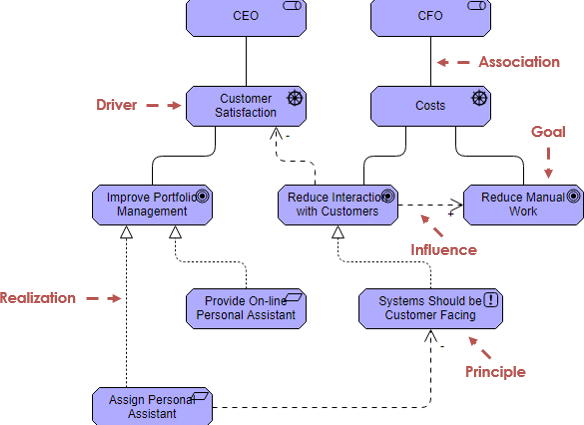
Introduction to Motivation Viewpoint The Motivation Viewpoint, also known as the Goals View, is a critical component of enterprise architecture frameworks, particularly within the ArchiMate® modeling language. This viewpoint is designed to illustrate the reasons behind changes and developments within an organization, providing a clear understanding of the drivers, goals,Read More →