


In the evolving landscape of enterprise architecture (EA), clarity, alignment, and adaptability are no longer optional—they are imperative. With the release of ArchiMate Next, the modeling language undergoes a transformative evolution, introducing the Hexagonion Framework as its new visual and conceptual cornerstone. At the heart of this innovation lies the Central Hub—a dynamic, symbolic, and structurally intelligent core that redefines how we model, connect, and align enterprise domains.
This article explores the significance, structure, and practical impact of the Central Hub within the Hexagonion Framework, illustrating how it advances EA from a rigid, layered discipline into a fluid, stakeholder-driven practice.
From Layers to Hexagon: A Visual and Conceptual Revolution
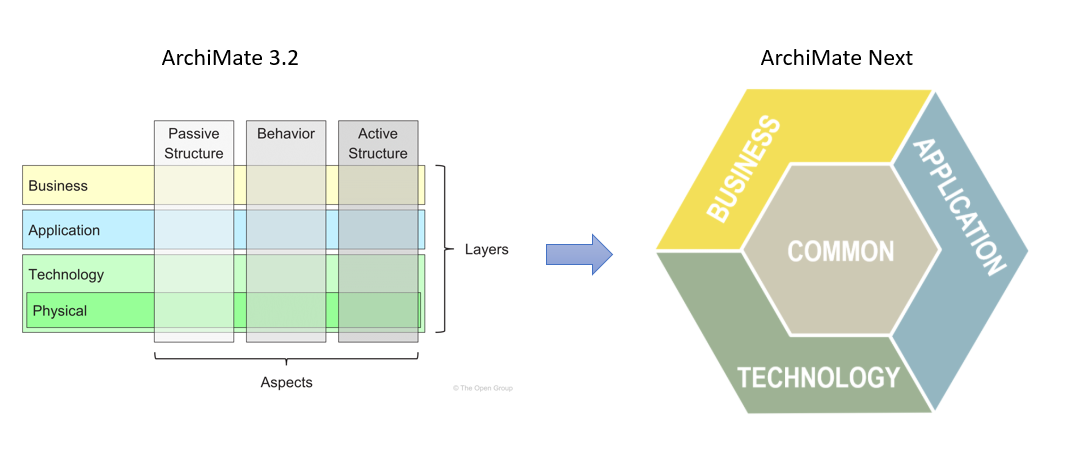
Traditional ArchiMate models have long relied on a rectangular, three-layered matrix—Business, Application, and Technology—each subdivided into aspects like structure, behavior, and passive structure. While effective in certain contexts, this model inherently promotes top-down thinking, hierarchical bias, and domain silos, often obscuring the interconnected nature of modern enterprises.
Enter ArchiMate Next, a forward-looking evolution that replaces the matrix with the Hexagonion—a hexagonal visualization that reflects the complexity, fluidity, and interdependence of today’s organizations. The Hexagonion is not merely a new diagram style; it is a fundamental reimagining of architectural thinking.
At its center—the Central Hub—resides the essence of the language: a balanced, integrative core that unifies strategy, operations, and transformation.
The Core of the Framework: Three Foundational Aspects
The Central Hub is built upon the three primary aspects of the ArchiMate language, now elevated to the heart of the modeling approach:
1. Active Structure
Entities capable of initiating or performing actions—such as roles, actors, components, or generic active elements—form the “who” or “what” in the enterprise.
Example: A Customer Support Agent, a Cloud Service, or a Digital Channel.
2. Behavior
Units of activity that define what happens—including processes, functions, services, and events. In ArchiMate Next, these have been merged and generalized to reduce redundancy and enhance expressiveness across domains.
Example: A “Customer Onboarding Service” or “Data Validation Function.”
3. Passive Structure
Objects acted upon—informational or physical entities that are created, modified, or consumed. These are the “what is affected.”
Example: Customer Data, Product Catalog, or Order Record.
Together, these three aspects form the metamodelic foundation of the Hexagonion. They are not confined to layers but exist in a flexible, interconnected space, allowing architects to model any enterprise element with precision and context.
Symbolic Center: Motivation as the Gravitational Core
One of the most profound shifts in ArchiMate Next is the symbolic placement of Motivation at the absolute center of the Hexagonion.
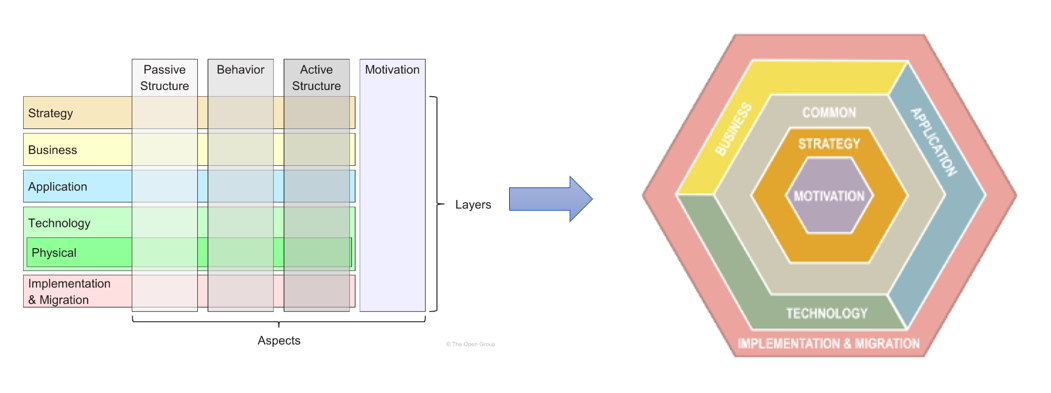
In earlier versions, motivation (goals, drivers, principles, requirements) was often treated as a top-layer add-on—a kind of afterthought. In the new framework, it is the origin point of all architectural decisions.
Why This Matters:
-
Prevents technical drift: Ensures that every design choice is traceable back to a stakeholder need.
-
Centers the “why”: Aligns architecture with strategic intent, not just technical feasibility.
-
Enhances accountability: Every element in the model can be asked: “Does this serve a motivation?”
🌟 Key Principle: Everything radiates from and returns to the Center of Motivation.
This intentional design ensures that architecture remains purpose-driven, not merely process-driven.
Structural Function: The Hub-and-Spoke Architecture
Visually, the Central Hub functions like the hub of a wheel, with spokes extending outward to connect different domains of the enterprise. These spokes represent bidirectional relationships, breaking the rigid top-down flow of traditional models.
The Spokes Connect:
| Domain | Location in Hexagon | Purpose |
|---|---|---|
| Strategic | Upper/outer regions | Strategy, capabilities, courses of action |
| Operational | Surrounding mid-level areas | Business, application, and technology processes |
| Transformational | Lower/outer regions | Implementation, migration, change, and delivery |
This structure:
-
Eliminates artificial layering.
-
Supports non-linear, iterative modeling.
-
Encourages feedback loops between strategy, execution, and change.
The result? A balanced, holistic view where strategic intent informs operational design, which in turn shapes technological implementation—all anchored in shared motivation.
Operational Integration: A Seamless Flow of Value
The Central Hub is not just a conceptual anchor—it is a functional integrator of enterprise processes. It enables a clear, traceable flow from intent to outcome:
Motivation → Strategy → Operational Hub → Implementation → Technology → Outcomes
Each step is connected through the hub, ensuring:
-
Traceability: Every implementation decision can be linked to a strategic goal.
-
Alignment: No siloed initiatives; all elements support a unified purpose.
-
Adaptability: Changes in motivation (e.g., new compliance rules) ripple through the model, triggering updates across domains.
This flow supports continuous alignment in fast-changing environments—critical for digital transformation, regulatory compliance, and agile innovation.
Benefits of the Hexagonion Central Hub Approach
The shift to the Central Hub brings tangible advantages to enterprise architecture practice:
| Benefit | Explanation |
|---|---|
| Reduced Hierarchical Bias | No more “top-down” mandates. Domains are flexible and interdependent. |
| Enhanced Stakeholder Alignment | Motivation-centered design ensures all parties see the “why” behind decisions. |
| Simplified, Expressive Metamodel | Unified behavior elements (e.g., merged processes and services) reduce complexity without sacrificing depth. |
| Improved Communication | The hexagonal structure visually highlights interdependencies, making models more intuitive for non-technical stakeholders. |
| Support for Dynamic Change | The hub enables rapid reconfiguration in response to shifting goals, markets, or regulations. |
Practical Applications: Real-World Impact
Example 1: Digital Transformation Initiative
Goal: Launch a new mobile app to improve customer experience.
-
Center (Motivation):
-
Driver: “Improve customer satisfaction”
-
Goal: “Achieve NPS > 80”
-
Principle: “Customer-centric design”
-
-
Hub (Core Aspects):
-
Active: Customer-facing Role (generic in ArchiMate Next)
-
Behavior: Customer Journey Process / Service (unified)
-
Passive: Customer Data Object
-
-
Spokes:
Motivation → Strategic Capability (“Omnichannel Engagement”)
→ Operational Hub → Application Service
→ Technology Node (cloud-based platform)
✅ Outcome: The model shows how customer-centric goals directly shape technical choices—no disconnect between business and IT.
Example 2: Compliance-Driven Change (GDPR)
Driver: Regulatory requirement to encrypt personal data.
-
Center:
-
Driver: “GDPR compliance”
-
Risk: “High chance of fines”
-
Requirement: “Encrypt all personal data”
-
-
Hub:
-
Active: Data Protection Role
-
Behavior: Data Encryption Function
-
Passive: Personal Data Object
-
-
Flow:
Motivation → Strategy (new security capability)
→ Operational Hub (updated processes/services)
→ Transformation (migration to encrypted storage)
✅ Outcome: The central hub prevents isolated fixes. Security is modeled as a systemic, motivation-driven effort.
Example 3: Simple Retail Enterprise View
Core Motivation: “Maximize profitable sales growth”
-
Hub:
-
Active: Store Actor / Role
-
Behavior: Sales Process → Payment Service
-
Passive: Product Object, Order Object
-
-
Spokes:
→ Upward: Strategy (expand online sales capability)
→ Downward: Technology (POS system, e-commerce platform)
✅ Outcome: The model reveals balanced interconnections—no pyramid of layers, just a cohesive, integrated view of the business.
Conclusion: A New Era of Purpose-Driven Architecture
The Central Hub of the Hexagonion Framework in ArchiMate Next is more than a diagrammatic innovation—it is a philosophical and methodological shift in how we approach enterprise architecture.
By:
-
Placing Motivation at the center,
-
Unifying Active Structure, Behavior, and Passive Structure in a dynamic hub,
-
Using spoke-like connections to link strategy, operations, and transformation,
ArchiMate Next enables a more holistic, adaptive, and stakeholder-aligned approach to modeling.
This is not just about better diagrams—it’s about better decision-making, stronger alignment, and greater resilience in the face of constant change.
As enterprises evolve in complexity and pace, the Central Hub stands as a beacon: a reminder that architecture must always serve the purpose, not just the process.
✨ In the Hexagonion, the center is not empty—it is alive with purpose.
Next Steps for Practitioners
-
Begin modeling with Motivation first—ask: “What are we really trying to achieve?”
-
Use the Central Hub as the starting point for all new models.
-
Leverage the spoke structure to visualize and validate cross-domain dependencies.
-
Share models using the Hexagonion format to improve stakeholder understanding and buy-in.
The future of enterprise architecture is not layered—it is connected.
And it all begins in the Center.