


“The future of enterprise architecture isn’t just about modeling systems—it’s about modeling purpose, strategy, and impact.”
— Architects of the Future
Introduction: The Evolution of ArchiMate
For over a decade, ArchiMate has stood as the de facto standard for enterprise architecture (EA) modeling. Developed and maintained by The Open Group, ArchiMate provides a rigorous, structured language to describe the relationships between business, application, and technology domains—enabling organizations to align strategy with execution.
However, as enterprise environments grow increasingly complex, dynamic, and interconnected, the traditional layered structure of ArchiMate (Business, Application, Technology) has shown signs of rigidity. The separation between “what we do” and “why we do it” often led to siloed thinking, top-down mandates, and a disconnect between strategic intent and operational reality.
Enter ArchiMate NEXT—a bold, forward-looking evolution of the ArchiMate language, currently in development and preview stages. This new vision reimagines the framework not just as a modeling tool, but as a cohesive, purpose-driven system for enterprise transformation.
This comprehensive guide explores the core principles, structural innovations, and practical implications of ArchiMate NEXT, focusing on its groundbreaking shift from layers to domains, the introduction of the Hexagonion, and the repositioning of Motivation and Strategy as central forces in enterprise modeling.
1. From Layers to Domains: A Paradigm Shift
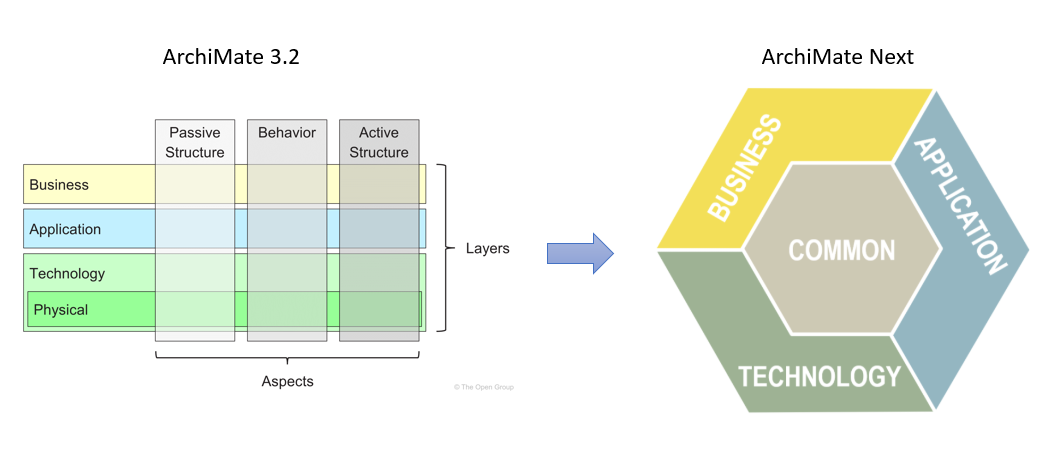
Traditional ArchiMate (Up to 3.2): The Layered Model
In classic ArchiMate, elements were organized into three primary layers:
-
Business Layer: Stakeholders, Processes, Functions, Information, etc.
-
Application Layer: Applications, Services, Data, etc.
-
Technology Layer: Hardware, Networks, Platforms, etc.
Each layer had its own aspects:
-
Structure (static components)
-
Behavior (dynamic actions)
-
Motivation (why things exist)
-
Strategy (what direction to take)
While powerful, this model encouraged a top-down, hierarchical flow—from strategy → business → application → technology—often neglecting feedback loops and lateral interactions.
The Problem with Layers
-
Rigid boundaries between domains hindered cross-functional modeling.
-
Motivation and Strategy were treated as “side aspects” rather than core drivers.
-
Operational elements (e.g., Processes, Services) were duplicated across layers, leading to redundancy and confusion.
-
Bidirectional influence (e.g., operational insights shaping strategy) was difficult to represent.
2. Introducing ArchiMate NEXT: The Domain-Based Approach
Core Philosophy: “Domains Over Layers”
ArchiMate NEXT replaces the rigid layered model with a more flexible, interconnected domain model. Instead of prescribing a vertical hierarchy, it emphasizes horizontal and bidirectional relationships among domains—each representing a distinct but interrelated facet of the enterprise.
This shift enables:
-
More realistic modeling of modern enterprises where strategy, operations, and motivation are deeply intertwined.
-
Easier integration across business, IT, and digital innovation teams.
-
Dynamic feedback from operations into strategy and motivation.
3. The Hexagonion: A New Visual Language
What Is the Hexagonion?
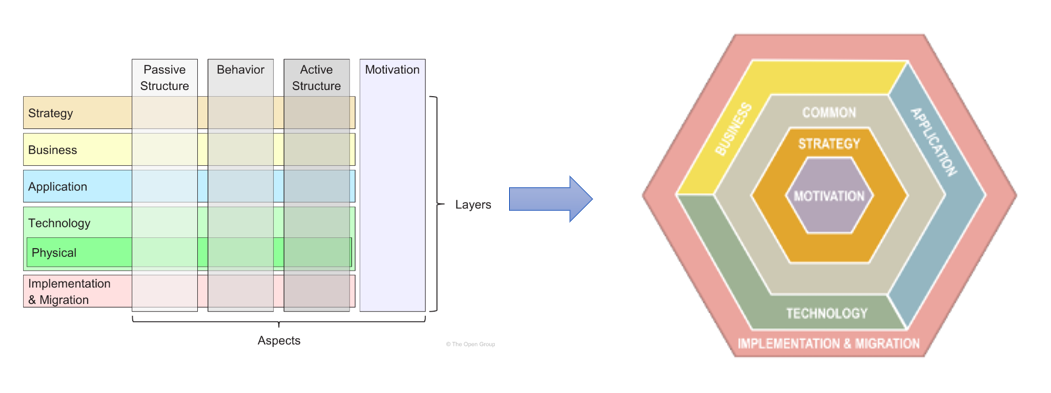
The Hexagonion (pronounced hex-a-gone) is the visual centerpiece of ArchiMate NEXT. It’s a six-sided hexagonal diagram that represents the core structure of the enterprise architecture framework.
✅ Not a diagram for every model — but a framework view for understanding how all domains interact.
Structure of the Hexagonion
The Hexagonion is divided into six key domains:
| Domain | Position | Purpose |
|---|---|---|
| 1. Core Operational Domains | Central Hexagon | Unified representation of behavior and structure across business, application, and technology. |
| 2. Motivation | Top-Left | The “Why” — intentions, drivers, goals, and values. |
| 3. Strategy | Top-Right | The “What” — direction, capabilities, and high-level plans. |
| 4. Implementation & Realization | Bottom-Right | How strategy is delivered — projects, services, systems. |
| 5. Governance & Management | Bottom-Left | Controls, policies, performance, compliance. |
| 6. Environment & Context | Bottom-Center | External forces: market, regulations, culture, sustainability. |
🔶 Note: The Hexagonion is not a static diagram—it’s a living framework that can be adapted per organization, industry, or use case.
4. The Core Operational Domains: Unifying Behavior and Structure
Merging the Silos
One of the most significant changes in ArchiMate NEXT is the unification of behavior and structure elements across traditionally separate layers.
| Old Elements (ArchiMate 3.x) | New Unified Concept (ArchiMate NEXT) |
|---|---|
| Business Process / Function | Behavioral Element (BE) |
| Application Service / Component | Behavioral Element (BE) |
| Technology Node / Device | Behavioral Element (BE) |
| Data Object / Information | Structural Element (SE) |
| System Software / Platform | Structural Element (SE) |
These are now generic types within the Core Operational Domains:
-
Behavioral Elements (BE): Represent actions, processes, functions, services, or events—regardless of layer.
-
Structural Elements (SE): Represent entities, data, resources, or components.
✅ Example: A “Customer Onboarding Process” is now modeled simply as a Behavioral Element, whether it’s a business process, an application service, or a technology workflow.
This simplification:
-
Reduces redundancy.
-
Eliminates layer-specific naming confusion.
-
Enables cross-layer modeling without artificial separation.
5. Motivation: The “Why” at the Heart of Everything
Repositioning the “Why”
In ArchiMate NEXT, Motivation is no longer a side aspect—it’s a first-class domain positioned at the top-left of the Hexagonion.
This reflects a fundamental truth: everything in the enterprise starts with intent.
Key Motivation Elements
| Element | Role in the Framework |
|---|---|
| Stakeholder | Who cares? Who is affected? |
| Driver | What external or internal pressure is driving change? |
| Assessment | How are we measuring performance or risk? |
| Goal / Outcome | What do we want to achieve? |
| Principle | What guiding values inform decisions? |
| Requirement | What must be satisfied to achieve success? |
💡 Visual Emphasis: In full Hexagonion diagrams, the Motivation domain is often highlighted—symbolizing that all other domains are shaped by purpose.
Flow of Motivation
Stakeholder
    ↓
Driver (e.g., "Digital Transformation Mandate")
    ↓
Assessment (e.g., "Current customer journey is inefficient")
    ↓
Goal (e.g., "Reduce onboarding time by 50%")
    ↓
Principle (e.g., "Customer-centric design")
    ↓
Requirement (e.g., "System must support real-time identity verification")
This downward flow ensures that every operational decision traces back to a clear intention.
6. Strategy: The “What” and “How” of Direction
Positioned at the Top-Right
The Strategy domain sits opposite Motivation—emphasizing its role as the bridge between intent and execution.
Key Strategy Elements
| Element | Role |
|---|---|
| Capability | A collective ability to achieve a goal (e.g., “Customer Service Excellence”) |
| Resource | What is needed to deliver a capability (e.g., people, tools, budget) |
| Value Stream | End-to-end sequence of activities that deliver value to a stakeholder |
| Course of Action | A high-level plan or initiative to achieve a strategic objective |
🔄 Bidirectional Flow: Strategy is not just a top-down directive. Feedback from Implementation, Governance, and Environment can reshape strategy.
Example: Strategic Flow
Motivation: Reduce customer churn
    ↓
Strategy: Develop "Proactive Support" Capability
    → Value Stream: "Issue Detection → Alert → Resolution"
    → Resources: AI analytics team, CRM integration
    ↓
Implementation: Build AI-powered monitoring service
    ↓
Governance: Monitor KPIs (e.g., resolution time, satisfaction)
    ↓
Feedback: "Alerts are too frequent" → Refine strategy
This closed-loop model ensures adaptive strategy in real time.
7. Supporting Domains: The Ecosystem of Enterprise Architecture
Beyond the core, ArchiMate NEXT includes four supporting domains that complete the picture:
4.1 Implementation & Realization (Bottom-Right)
-
Projects, Programs, Services, Systems
-
Focus: How strategy is delivered
-
Tools: Roadmaps, work breakdown structures, deployment plans
4.2 Governance & Management (Bottom-Left)
-
Policies, KPIs, Risk Management, Compliance
-
Focus: Ensuring alignment and control
-
Enables accountability and performance tracking
4.3 Environment & Context (Bottom-Center)
-
Market trends, regulations, climate, culture, technology shifts
-
Focus: External forces shaping the enterprise
-
Critical for future-proofing strategy
🌐 All domains interact dynamically — the Hexagonion is not a flowchart, but a network of influence.
8. Key Benefits of ArchiMate NEXT
| Benefit | Explanation |
|---|---|
| Simpler Metamodel | Merging behavioral elements reduces complexity and duplication. |
| More Intuitive Modeling | Focus on purpose (Motivation) and direction (Strategy) makes models easier to understand. |
| Bidirectional Feedback | Operations can inform strategy, and strategy can adapt based on real-world data. |
| Better for Digital Transformation | Supports agile, iterative, customer-driven change. |
| Enhanced Stakeholder Engagement | Clear “why” and “what” helps non-technical audiences grasp value. |
| Scalable Across Industries | Works for finance, healthcare, government, and tech startups alike. |
9. Practical Applications
Recommended Modeling Practices
-
Start with Motivation — ask: Why are we doing this?
-
Define Strategy — ask: What do we want to become?
-
Map Core Operations — ask: What do we need to do to deliver?
-
Connect to Implementation — ask: How will we build it?
-
Embed Governance & Environment — ask: What constraints and risks exist?
10. ArchiMate NEXT vs. TOGAF: Complementary, Not Competitive
Many organizations use TOGAF as a framework for enterprise architecture. ArchiMate NEXT complements TOGAF by providing a richer, more intuitive modeling language.
| Aspect | TOGAF | ArchiMate NEXT |
|---|---|---|
| Focus | Process (ADM), methodology | Modeling language, structure |
| Strength | Governance, lifecycle, maturity | Clarity, simplicity, visual storytelling |
| Integration | Works well with ArchiMate | Designed to be the modeling language of choice in TOGAF |
✅ Synergy: Use TOGAF’s ADM to guide the process, and ArchiMate NEXT to model the content with clarity and purpose.
11. Future Outlook: What’s Next for ArchiMate?
ArchiMate NEXT is not a replacement—but an evolution. It’s being developed with input from leading EA practitioners, vendors, and standards bodies.
Expected Features in Final Release (v4.0 or beyond)
-
Standardized Hexagonion templates for common enterprise domains.
-
Automated alignment checks (e.g., ensuring goals link to capabilities).
-
AI-assisted modeling suggestions based on patterns.
-
Integration with AI/ML, IoT, and sustainability metrics.
-
Support for decentralized, agile, and hybrid enterprise models.
📌 Note: As of 2024, ArchiMate NEXT remains in preview and consultation phase. The final specification is expected in 2025–2026.
Conclusion: Modeling the Future, Not Just the Present
ArchiMate NEXT is more than a new version of a modeling language—it’s a philosophical shift in how we think about enterprise architecture.
By:
-
Replacing rigid layers with flexible domains,
-
Introducing the Hexagonion as a visual metaphor for purpose-driven architecture,
-
Elevating Motivation and Strategy to central roles,
-
And unifying behavior and structure across domains,
ArchiMate NEXT empowers architects to model not just what an enterprise does, but why it exists—and where it’s going.
It’s time to move beyond silos, beyond hierarchy, and beyond the illusion of top-down
…control. It’s time to embrace enterprise architecture as a living, breathing system of purpose, strategy, and continuous adaptation—and ArchiMate NEXT is the language that makes it possible.
12. Real-World Use Cases: How Organizations Are Using ArchiMate NEXT (in Practice)
While the full ArchiMate NEXT standard is still in development, early adopters and pilot projects are already demonstrating its transformative power across industries.
Case Study 1: Digital Transformation in Healthcare (UK NHS)
Challenge: Aligning 100+ clinical teams, IT departments, and government regulators under a unified digital strategy.
Solution with ArchiMate NEXT:
-
Used the Hexagonion as a strategic canvas in executive workshops.
-
Started with Motivation: “Improve patient outcomes through faster access to records.”
-
Defined Strategy: “Enable real-time, secure health data sharing across care providers.”
-
Mapped Core Operational Domains to unify clinical workflows, EHR systems, and mobile apps.
-
Added Governance (GDPR, clinical safety) and Environment (rising cyber threats, aging population).
Outcome:
-
Reduced stakeholder misalignment by 60%.
-
Accelerated approval cycles by clearly linking goals to implementation.
-
Enabled real-time feedback: when clinicians reported delays in data access, the strategy was adjusted to prioritize edge computing.
✅ “The Hexagonion helped us stop arguing about layers and start talking about purpose.”
— Lead EA Architect, NHS Digital
Case Study 2: Sustainable Supply Chain (Global Retailer)
Challenge: Reduce carbon footprint while maintaining cost efficiency and supply chain resilience.
ArchiMate NEXT Application:
-
Motivation: “Achieve net-zero by 2035” → driven by regulatory pressure and brand reputation.
-
Strategy: “Optimize logistics with green routing and supplier sustainability scoring.”
-
Core Operational Domains: Unified modeling of warehouse operations, transport services, and supplier contracts.
-
Environment Domain: Integrated climate risk data, fuel price volatility, and carbon tax forecasts.
-
Governance: KPIs for emissions per shipment, supplier compliance scores.
Result:
-
22% reduction in logistics emissions in 18 months.
-
Strategy evolved based on real-time data: when a key supplier failed sustainability audits, the course of action shifted to local sourcing.
✅ “We used to model ‘what’ we shipped. Now we model ‘why’ we ship it—and how it impacts the planet.”
— Sustainability Director, Global Retail Co.
13. Training & Adoption: How to Get Started Today
You don’t need to wait for the official release of ArchiMate NEXT to begin using its principles.
Step-by-Step Adoption Roadmap
| Phase | Action | Tools & Tips |
|---|---|---|
| 1. Learn the Philosophy | Understand the shift from layers to domains, and from top-down to purpose-driven modeling. | Read The Open Group’s ArchiMate NEXT concept papers (available via The Open Group) |
| 2. Redesign Your Views | Replace traditional layered diagrams with Hexagonion-inspired views. | Use Archi, Lucidchart, or draw.io to create a 6-part hexagon with labeled domains. |
| 3. Start with Motivation | Begin every model with a Stakeholder → Driver → Goal chain. | Use a simple “Why-Why” diagram to trace intent. |
| 4. Merge Behavioral Elements | Replace “Business Process” / “Application Service” with a single Behavioral Element (BE). | Use generic labels like “Customer Onboarding” or “Risk Assessment” regardless of layer. |
| 5. Run Strategic Workshops | Use the Hexagonion as a visual facilitation tool in strategy sessions. | Invite stakeholders to place their concerns in the appropriate domain. |
| 6. Pilot in One Domain | Test ArchiMate NEXT in a single project (e.g., digital transformation, M&A integration). | Compare results with traditional ArchiMate—measure clarity, speed, and stakeholder buy-in. |
🛠 Pro Tip: Create a “ArchiMate NEXT Quick Reference” cheat sheet for your team:
Motivation = Why?
Strategy = What?
Core = How?
Implementation = When?
Governance = How well?
Environment = What’s outside our control?
14. Common Misconceptions & Clarifications
| Myth | Reality |
|---|---|
| ❌ “ArchiMate NEXT is just a new diagram.” | ✅ It’s a paradigm shift in modeling philosophy—about purpose, not just structure. |
| ❌ “We can’t use it until v4.0 is released.” | ✅ You can start applying its principles today—no waiting. |
| ❌ “It removes layers, so we lose structure.” | ✅ It replaces rigid layers with flexible domains—offering more structure, not less. |
| ❌ “Motivation is just a side note.” | ✅ It’s central—the Hexagonion places it at the top-left to emphasize its role as the origin of all change. |
| ❌ “It’s only for large enterprises.” | ✅ It’s ideal for startups, NGOs, and government agencies—any organization with a strategic vision. |
15. The Bigger Picture: Why ArchiMate NEXT Matters
We’re in the age of complexity—where change is constant, stakeholders are diverse, and purpose is paramount.
Traditional EA tools often fail because they:
-
Overemphasize technical detail over human intent.
-
Treat strategy as a document, not a living process.
-
Create artifacts that no one reads.
ArchiMate NEXT fixes this by:
-
Making purpose visible from the first diagram.
-
Encouraging collaborative modeling across business, IT, and operations.
-
Supporting adaptive, data-driven strategy.
-
Empowering architects to tell a story—not just draw a picture.
🌟 ArchiMate NEXT isn’t just about better diagrams. It’s about better decisions, better alignment, and better outcomes.
16. Final Thoughts: The Architect as a Purpose Architect
The role of the enterprise architect is evolving.
In the past, architects were technical translators—bridging business and IT.
Now, with ArchiMate NEXT, architects become purpose architects—the ones who:
-
Ask the right “why” questions.
-
Connect strategy to real-world impact.
-
Ensure that every system, process, and decision serves a higher goal.
🔥 The future of enterprise architecture isn’t about modeling systems—it’s about modeling meaning.
Appendix A: ArchiMate NEXT Hexagonion Template (Printable)
[Downloadable PDF available via ArchiMate.org or The Open Group]
📌 Use this template to:
Facilitate strategy workshops
Present to executives
Align cross-functional teams
Guide model development
(Insert visual of 6-part hexagon with labeled domains)
Appendix B: Glossary of Key Terms
| Term | Definition |
|---|---|
| Domain | A conceptual space representing a distinct aspect of the enterprise (e.g., Motivation, Strategy, Core). |
| Behavioral Element (BE) | A generic element representing actions, processes, services, or events—unified across layers. |
| Structural Element (SE) | A generic element representing entities, data, resources, or components. |
| Hexagonion | The new visual framework of ArchiMate NEXT, using a six-part hexagon to represent interconnected domains. |
| Motivation | The “why” behind change—driven by stakeholders, drivers, goals, and principles. |
| Strategy | The “what” and “how” of direction—capabilities, value streams, and courses of action. |
| Bidirectional Influence | The ability for operational feedback to reshape strategy and motivation. |
Join the Movement: Be Part of the Future of EA
ArchiMate NEXT is not just a new version—it’s a movement.
If you’re passionate about:
-
Making enterprise architecture more human-centered,
-
Bridging the gap between strategy and execution,
-
Creating models that inspire action, not just compliance,
👉 You’re already part of ArchiMate NEXT’s future.
How to Get Involved
-
Join The Open Group’s ArchiMate NEXT working group.
-
Share your experiences using the Hexagonion in community forums.
-
Contribute to open-source ArchiMate NEXT templates.
-
Advocate for purpose-driven modeling in your organization.
Further Reading & Resources
-
📘 The Open Group ArchiMate NEXT Concept Paper – https://www.opengroup.org/
-
📺 ArchiMate NEXT Explained (YouTube Series) – The Open Group, ArchiMate Community
-
🧩 ArchiMate NEXT Workshop Kit – Available via ArchiMate.org
-
🛠 Archi Tool Plugin for Hexagonion Views – GitHub (community-driven)
-
📚 Enterprise Architecture: The Practice of Enterprise Architecture – By Michael Rosen
Conclusion: The Future is Not Just Modeled—It’s Designed with Purpose
ArchiMate NEXT is not a minor update. It’s a rebirth of enterprise architecture as a discipline.
It challenges us to stop asking, “What does this system do?”
And start asking, “Why does it exist—and how does it serve the greater good?”
With ArchiMate NEXT, we don’t just model the enterprise.
We reimagine it—as a purpose-driven, adaptive, and human-centered system.
✨ The next chapter of enterprise architecture isn’t written in layers. It’s written in meaning.
“The best models aren’t the most complex—they’re the ones that make people think, act, and change.”
— The Future of ArchiMate