


“Simpler. Smarter. More Connected.”
— The Vision Behind ArchiMate Next
In mid-2025, The Open Group unveiled ArchiMate® Next, Snapshot 1, marking the most significant evolution of the ArchiMate enterprise architecture (EA) language since ArchiMate 3.2. Designed in response to years of community feedback, this next-generation framework reimagines how we model complex organizations—not by adding more complexity, but by removing redundancy, unifying concepts, and embracing a more intuitive, visual structure.
At the heart of this transformation lies the Hexagonion—a bold, hexagonal rethinking of the traditional layered matrix. This article explores the core concepts, visual innovations, practical implications, and real-world applications of ArchiMate Next, offering a clear roadmap for architects, practitioners, and organizations ready to embrace the future of EA modeling.
🔷 The Core Problem: Complexity in Enterprise Architecture
For over a decade, ArchiMate 3.2 has served as the gold standard for enterprise architecture. Its layered structure—Business, Application, Technology—combined with three aspects (Active Structure, Behavior, Passive Structure) created a powerful, standardized language.
But with power comes complexity:
-
Redundant elements across domains (e.g., Business Process vs. Application Function)
-
Overuse of relationships and constraints
-
Diagrams cluttered with hierarchical dependencies
-
Difficulty modeling cross-domain interactions
These challenges hindered adoption, especially among non-specialists and agile teams.
Enter ArchiMate Next.
🌟 Introducing the Hexagonion: A Paradigm Shift in EA Modeling
The Hexagonion is not just a new diagram style—it’s a fundamental redesign of the ArchiMate framework, built on three guiding principles:
-
Simplification – Fewer elements, less redundancy
-
Unification – Shared semantics across domains
-
Flexibility – No rigid hierarchy; domains interact dynamically
✅ What Is the Hexagonion?
The Hexagonion replaces the traditional 3×3 matrix with a symmetrical, hexagonal layout centered on the Core Framework, with Strategy & Motivation above and Implementation & Migration below.
This creates a modular, domain-first structure where:
-
Domains are equal partners, not hierarchical layers.
-
Relationships can be bidirectional or cross-domain without artificial constraints.
-
Diagrams are cleaner, more intuitive, and easier to interpret.
🎯 Think of it as a “hub-and-spoke” model, but with symmetry and balance—like a modern ecosystem of enterprise elements.
🧩 Core Hexagonion Framework: The Heart of ArchiMate Next
The Core Hexagonion represents the operational and execution layers of an organization—Business, Application, and Technology—now unified under a single, flexible framework.
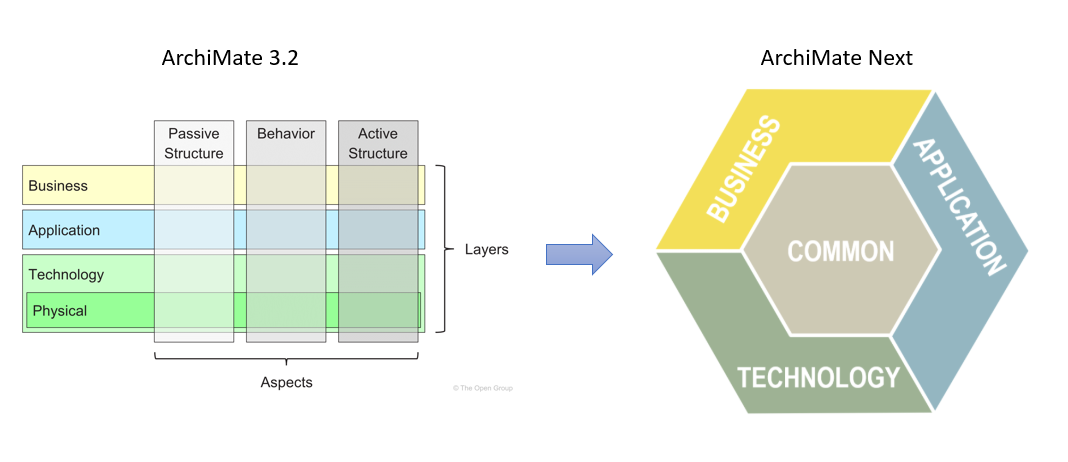
🔹 Key Features of the Core Hexagonion
| Feature | Description |
|---|---|
| Domain-Based Modeling | No more “top-down” dependency. Business, Application, and Technology are treated as equal domains, each with its own context. |
| Unified Element Types | Merges previously separate concepts into generic, cross-domain types. |
| Symmetrical Layout | Elements are arranged around a hexagon, promoting visual balance and interconnectedness. |
| Cardinality Support | Relationships now support precise instance-level modeling (e.g., 1..*, 0..1). |
🔹 Unified Element Types (The Big Simplifications)
| Original ArchiMate 3.2 | ArchiMate Next Equivalent | Why It Matters |
|---|---|---|
| Business Process | Generic Process | Same behavior, no domain-specific naming |
| Application Function | Generic Function | Unified across domains |
| Business Object | Generic Object | Covers data, documents, artifacts |
| Business Role | Generic Role | Assignable to any active element (no domain lock-in) |
| Collaboration | Unified Collaboration | Can span Business, Application, and Technology domains |
| Service (Business/Application/Technology) | Generic Service | One service type, used everywhere |
✅ Example: A “Customer Onboarding Service” can now be modeled as a Generic Service in the Business Domain, with a Generic Function in the Application Domain, and a Generic Process in the Technology Domain—all using the same semantics.
This semantic consistency reduces confusion and enables seamless integration across teams and systems.
🧱 Full Hexagonion Framework: From Strategy to Execution
The Full Hexagonion extends the Core by adding two critical tiers:
-
Top Tier: Strategy & Motivation (driving force)
-
Bottom Tier: Implementation & Migration (execution path)
This creates a three-tiered, hexagonally structured framework that supports end-to-end enterprise modeling.
📌 Full Hexagonion Structure
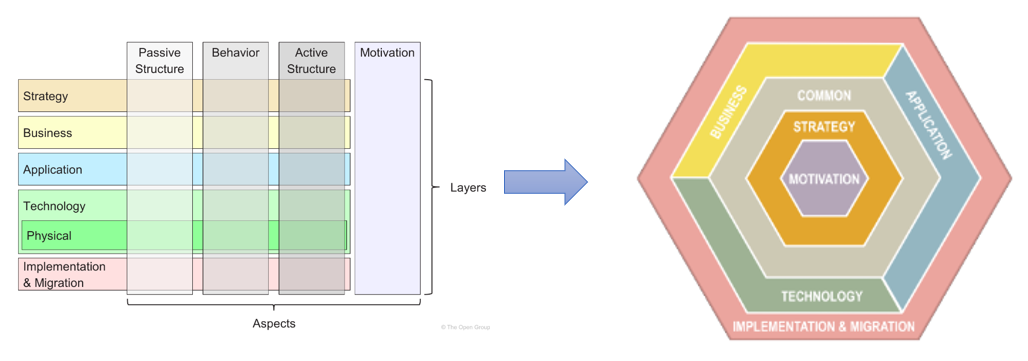
1. Strategy & Motivation (Top Hexagon)
Elements that define why the organization acts:
-
Capability – What the organization can do
-
Goal / Outcome – Desired future state
-
Driver / Principle / Requirement – What drives change
-
Assessment / Course of Action – Strategic decisions
🎯 Example: “Improve customer satisfaction by 20% in 12 months” → modeled as a Goal linked to a Capability and driven by a Driver.
2. Core Hexagonion (Center)
The operational heart: Business, Application, Technology domains unified.
🎯 Example: A Generic Service called “Order Fulfillment” spans:
Business: Customer-facing process
Application: API service in the CRM system
Technology: Containerized microservice on Kubernetes
3. Implementation & Migration (Bottom Hexagon)
Elements that define how change is realized:
-
Work Package – A unit of work
-
Deliverable – A tangible output
-
Plateau – A stable state during transition
-
Gap – Removed in Snapshot 1 (replaced by more dynamic assessment)
🎯 Example: “Migrate legacy CRM to cloud” → modeled as a Work Package linked to Deliverables like “New API Layer” and “Data Migration Script.”
⚠️ Note: The Gap element was removed in Snapshot 1 to reduce clutter and encourage continuous assessment instead of static gap analysis.
✨ Key Simplifications in ArchiMate Next
| Change | Impact |
|---|---|
| Removed Elements | Composition, Interaction, Constraint, Contract, Gap, Representation → less diagram clutter |
| Unified Behavior Types | Service, Process, Function, Event → all now Generic Behavior |
| Unified Active Structure | Role, Collaboration → now Generic Role and Collaboration (domain-agnostic) |
| Cardinality on Relationships | Now supports 0..1, 1..*, 1..1 → enables precise modeling of real-world dependencies |
| No More Layered Dependencies | No implied “Business → Application → Technology” flow; domains interact freely |
💡 Pro Tip: Use cardinality to model real-world constraints.
Example: A Generic Role (e.g., “Customer”) can perform 0.. Services*, but a Generic Service (e.g., “Login”) must be invoked by exactly 1 Role.
🖼️ Visual Representation: From Matrix to Hexagon
| ArchiMate 3.2 | ArchiMate Next (Hexagonion) |
|---|---|
| 3×3 matrix with layers | Symmetrical hexagon with 3 core domains |
| Horizontal flow (top-down) | Circular, interconnected relationships |
| Element duplication across layers | Single, unified element types |
| Visual clutter from multiple relationships | Cleaner, more scalable diagrams |
🎨 Example: Customer Onboarding Workflow (Hexagonion View)
          [Strategy & Motivation]
                (Goal: 95% Onboarding Success)
                     ↓
        ┌─────────────────────┐
        │   Core Hexagonion   │
        │  (Business/App/Tech)│
        └─────────────────────┘
               ↑    ↓    ↑
     [Generic Role] [Generic Service] [Generic Object]
       (Customer)     (Onboarding)    (Customer Profile)
               ↓    ↑    ↓
          [Implementation & Migration]
               (Work Package: "Deploy Onboarding API")
✅ This single diagram now captures strategy, execution, and cross-domain logic in a clean, readable format.
🛠️ Practical Implications & Adoption Guidance
✅ Benefits of ArchiMate Next
-
Easier onboarding for new architects and business stakeholders
-
Faster diagram creation with fewer, more intuitive elements
-
Better support for agile and hybrid environments
-
Improved communication across IT, business, and strategy teams
-
Backward compatibility with ArchiMate 3.2 (most models migrate with minimal changes)
⚠️ Challenges & Considerations
-
Still a draft (Snapshot 1, mid-2025): Final release may evolve based on community feedback
-
Tooling lag: Most EA tools (e.g., Archi, Sparx EA, LeanIX) will need updates to support Hexagonion
-
Training & cultural shift: Teams must unlearn old patterns and embrace domain-agnostic thinking
-
Migration effort: Assess existing repositories—some 3.2 models may need refactoring
📌 When to Use Which Version?
| Use Case | Recommended Framework |
|---|---|
| Quick operational modeling (e.g., process flows) | Core Hexagonion |
| Strategic planning & roadmap visualization | Full Hexagonion |
| Agile teams needing lightweight models | Core Hexagonion |
| Enterprise-wide EA programs with governance | Full Hexagonion |
| Legacy system documentation | ArchiMate 3.2 (for now) |
📚 Getting Started with ArchiMate Next
-
Download the Official Specification
→ ArchiMate Next Specification, Snapshot 1 (The Open Group Publications Library) -
Explore Community Feedback
→ Join the ArchiMate Next Working Group (via The Open Group forums) -
Try It in Your Tools
-
Check for updates in Archi, EA Studio, or other EA platforms
-
Use custom templates to prototype Hexagonion diagrams
-
-
Train Your Team
-
Focus on unified elements and cardinality modeling
-
Run workshops comparing 3.2 vs. Hexagonion diagrams
-
🏁 Conclusion: A Lighter, Smarter Future for EA
ArchiMate Next isn’t just an update—it’s a philosophical shift toward practical, inclusive, and human-centered enterprise architecture.
The Hexagonion framework:
-
Simplifies the language without sacrificing power
-
Unifies domains and behaviors
-
Empowers cross-functional collaboration
-
Visualizes strategy-to-execution flows with elegance
As The Open Group continues to refine ArchiMate Next based on community input, one thing is clear: the future of enterprise architecture is more connected, more flexible, and more accessible than ever before.
🔗 Stay Updated
Visit: https://www.opengroup.org/archimate
Reference: ArchiMate® Next Specification, Snapshot 1 (s250)