“A model is not just a diagram—it is a language. And like any powerful language, it must be intuitive, consistent, and rooted in familiar patterns.”
This guide provides a comprehensive, practical, and conceptually grounded understanding of the three core aspects of ArchiMate Next: Active Structure, Behavior, and Passive Structure. These foundational pillars are not only preserved but elevated in ArchiMate Next as the central organizing principle of the entire modeling language—now anchored in the Hexagonion framework.
Whether you’re a business architect, enterprise IT strategist, or solution designer, this guide will help you master the logic, structure, and application of ArchiMate Next through real-world clarity and intuitive reasoning.
🔷 Why These Three Concepts Matter: The Natural Language Analogy
ArchiMate’s design philosophy is deeply inspired by natural language syntax:
Subjects (who) → Verbs (what they do) → Objects (what they act upon)
This analogy makes ArchiMate intuitive and accessible:
| Natural Language | ArchiMate Next Equivalent |
|---|---|
| Subject (e.g., “The manager”) | Active Structure Element |
| Verb (e.g., “approves”) | Behavior Element |
| Object (e.g., “the expense report”) | Passive Structure Element |
This Subject-Verb-Object (SVO) model is not just a metaphor—it’s the semantic backbone of ArchiMate Next.
✅ Key Insight: When you model anything in ArchiMate Next, ask:
“Who is doing what to what?”
This question instantly reveals the correct elements to use.
🌟 The Three Core Aspects: A Deep Dive
Let’s explore each of the three core aspects in detail—what they are, how they work, and how they’re reimagined in ArchiMate Next.
1. Active Structure: The “Subjects” – Who Acts?
📌 Definition:
Active Structure Elements represent entities capable of initiating or performing behavior. They are the agents or actors in your enterprise model.
They are the doers—the ones who carry out processes, provide services, or collaborate with others.
🔹 Types of Active Structure Elements
| Type | Description | Examples |
|---|---|---|
| Internal Active Structure | Real, tangible entities that perform behavior internally. | Business roles, application components, nodes (servers), human actors, AI systems |
| External Active Structure (Interfaces) | Points of access where services are exposed to the outside world. They hide internal complexity and expose functionality. | Web APIs, service endpoints, public portals, external system interfaces |
💡 Tip: Think of an interface as a “window” into a system—what you see is what’s offered; the inner workings are hidden.
🔹 Evolution in ArchiMate Next
-
“Business Role” → “Role” (Generic)
No longer tied to business layer only. ARolecan now be assigned to:-
A person (e.g., “Customer Support Agent”)
-
A software component (e.g., “Payment Processing Module”)
-
A hardware device (e.g., “IoT Sensor Node”)
-
-
Interfaces are now first-class citizens
They are not just “connections”—they are active structures that represent service exposure points.
✅ Best Practice: Use
Interfacewhen modeling external access points. UseRoleto define responsibilities regardless of the underlying actor.
2. Behavior: The “Verbs” – What Is Being Done?
📌 Definition:
Behavior Elements represent dynamic aspects—the actions, activities, and events that occur within the enterprise.
They are the actions that active structures perform or trigger.
🔹 Types of Behavior Elements
| Type | Description | Examples |
|---|---|---|
| Internal Behavior | Units of activity performed by active structures. | Process, Function |
| External Behavior (Services) | Explicitly defined behaviors offered to external users. They deliver value. | Service, API, Business Service, Application Service |
| Events | Instantaneous state changes that trigger or result from behavior. | Start Event, End Event, Message Event, Timer Event |
🎯 Key Insight:
A Process is a sequence of behavior (like a workflow).
A Function is a logical grouping of behavior (like a capability).
A Service is behavior exposed externally—it’s about value delivery.
🔹 Unification in ArchiMate Next: The Power of Domain Agnosticism
One of the most significant improvements in ArchiMate Next is the unification of behavior across domains.
| Old Approach (ArchiMate 3.x) | New Approach (ArchiMate Next) |
|---|---|
Separate Business Process, Application Function, Technology Service |
One unified Process, Function, Service, Event across all layers |
| Duplicated elements with similar semantics | Single, domain-agnostic elements |
✅ Example:
AProcesscan be:
Performed by a human (business process)
Executed by a software component (application process)
Run by an AI agent (automated function)
No need to duplicate logic. One Process model suffices.
🛠️ Practical Tip:
UseServicewhen the behavior is intended for external consumption (e.g., “Customer Onboarding Service”).
UseProcessorFunctionwhen describing internal logic, regardless of the actor.
3. Passive Structure: The “Objects” – What Is Being Acted Upon?
📌 Definition:
Passive Structure Elements are entities that do not perform behavior but are acted upon or accessed by behavior.
They are the “nouns” in your model—the data, information, and physical assets that are created, modified, or consumed.
🔹 Types of Passive Structure Elements
| Type | Description | Examples |
|---|---|---|
| Business Objects | Information assets from a business perspective. | Customer records, contracts, invoices, product catalogs |
| Data Objects | Structured data used in automated processing. | Database tables, XML files, JSON payloads |
| Artifacts & Materials | Physical or executable entities in the technology and physical domains. | Executables, libraries, documents, energy, raw materials |
⚠️ Important: Passive structures cannot act—they are acted upon.
If something is doing something, it’s an Active Structure or Behavior.
🔹 Evolution in ArchiMate Next
-
No more layer-specific duplicates
No moreBusiness Data,Application Data,Technology Data. JustData Object—unified across domains. -
Contracts as Business Objects
Previously,Contractwas a standalone element. Now, it is a specialization of a Business Object, representing a formal agreement that is acted upon. -
Artifacts as physical or executable data
This includes.jar,.exe,.dllfiles—now clearly modeled as Artifacts, distinct from abstract data.
✅ Best Practice:
Ask: “Is this something being created, changed, or used?”
If yes → it’s a Passive Structure.
If no → it’s likely an Active Structure or Behavior.
🌀 The Hexagonion Framework: Where the Core Concepts Live
In ArchiMate Next, the traditional layered matrix (Business, Application, Technology) has been replaced by the Hexagonion Framework—a more holistic and dynamic structure.
🧩 The Center Hub: The Three Core Aspects
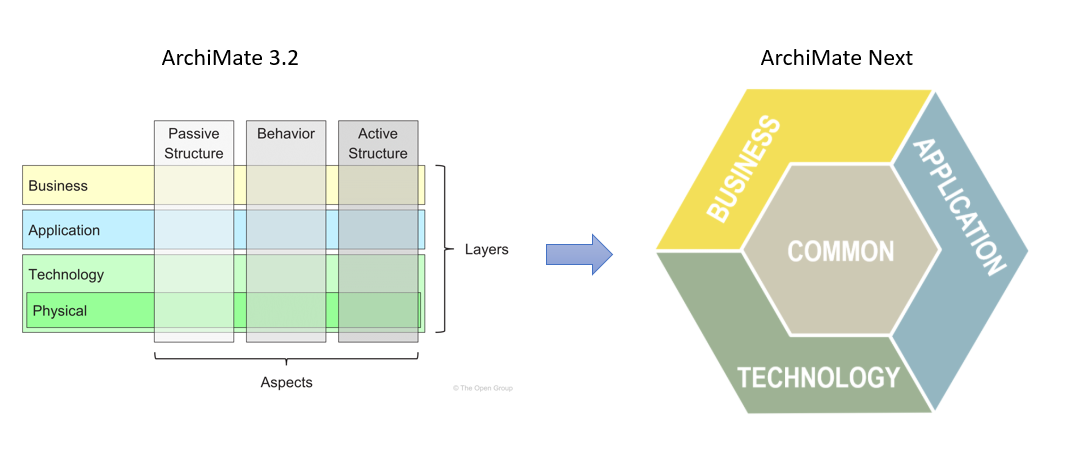
🔥 The Active Structure, Behavior, and Passive Structure are now placed at the very center of the Hexagonion.
This is not symbolic—it’s architectural.
-
All other domains radiate from this core.
-
Strategy, Motivation, Implementation, and Migration are extensions of the core SVO model.
               [Strategy]
                   |
         [Motivation] — [Implementation] — [Migration]
                   |
           [Core: Active | Behavior | Passive]
✅ Why This Matters:
You’re not modeling layers—you’re modeling enterprise reality.
The core three elements are universal and transcend domain boundaries.
🔄 How the Core Concepts Are Unified and Generalized
ArchiMate Next removes redundancy and complexity by generalizing key concepts into a Common Domain.
| Concept | Old (ArchiMate 3.x) | New (ArchiMate Next) | Benefit |
|---|---|---|---|
| Process | Business, Application, Technology versions | One unified Process |
No duplication, consistent semantics |
| Role | Business Role only | Generic Role |
Can be assigned to people, software, hardware |
| Collaboration | Layer-specific | Single Collaboration element |
Cross-layer teamwork modeled uniformly |
| Contract | Standalone element | Specialization of Business Object |
Semantic consistency |
| Interaction | Separate element | Replaced by Collaboration or Service |
Simpler, more meaningful |
📌 Key Principle:
If it’s not a core element, it’s a specialization or a relationship.
This reduces cognitive load and prevents model sprawl.
🧠 Semantic Continuity: The SVO Analogy in Action
Let’s bring the natural language analogy to life with a real-world example.
🏢 Example: Customer Onboarding Process
Question: Who does what to what?
| Part of Speech | ArchiMate Element | Example |
|---|---|---|
| Subject (Who?) | Business Role (now Role) |
“Customer Onboarding Specialist” |
| Verb (What?) | Process |
“Onboard New Customer” |
| Object (To What?) | Business Object |
“Customer Account” |
Now, let’s expand it:
-
The
Processis realized by a human (Role) and supported by anApplication Component(e.g., CRM system). -
The
Processuses aData Object(e.g.,Customer Profile). -
The
Processtriggers anEvent(“Customer Account Created”). -
The
Processexposes aService(“Customer Onboarding Service”) to external partners.
✅ Modeling Tip:
UseCollaborationto show that theOnboarding Specialistand theCRM Systemwork together to complete theProcess.
🧩 Metamodel Refinement: Simplicity Through Structure
ArchiMate Next simplifies the metamodel by:
-
Removing redundant elements:
-
Interaction→ replaced byCollaborationorService -
Constraint→ modeled as a property or relationship -
Contract→ specializedBusiness Object
-
-
Introducing clear hierarchies:
-
All Behavior elements inherit from
Behavior -
All Active Structures inherit from
Active Structure -
All Passive Structures inherit from
Passive Structure
-
This creates a clean, consistent, and extensible foundation.
✅ Design Rule:
If you’re unsure whether to use a new element, ask:
“Does this fit into the Active-Structure, Behavior, or Passive-Structure category?”
If yes → use the core element.
If no → it’s likely a specialization, relationship, or property.
✅ Summary: The ArchiMate Next Core Framework
| Aspect | Key Features | Best Practices |
|---|---|---|
| Active Structure | Subjects that act; roles, actors, interfaces | Use Role for responsibilities; Interface for external access |
| Behavior | Verbs: processes, functions, services, events | Use Service for external value; Process for internal workflows |
| Passive Structure | Objects acted upon: data, business objects, artifacts | Use Business Object for contracts; Data Object for structured data |
🌐 Golden Rule of ArchiMate Next:
Everything is either an Active Structure, a Behavior, or a Passive Structure.
If it doesn’t fit, it’s not a primary element—it’s a relationship, property, or specialization.
📚 Final Thoughts: Why This Matters for Enterprise Architects
ArchiMate Next is not just a version update—it’s a paradigm shift toward simplicity, consistency, and realism.
By anchoring the language in the three core aspects and placing them at the center of the Hexagonion, ArchiMate Next:
-
✅ Reduces complexity and model sprawl
-
✅ Improves readability and collaboration across teams
-
✅ Enables true end-to-end modeling across strategy, execution, and transformation
-
✅ Supports digital transformation with unified modeling of humans, software, and AI
📌 Quick Reference: Core Elements in ArchiMate Next
| Category | Element | Purpose |
|---|---|---|
| Active Structure | Role, Interface, Application Component, Node |
Who or what performs behavior |
| Behavior | Process, Function, Service, Event |
What is being done |
| Passive Structure | Business Object, Data Object, Artifact, Material |
What is being acted upon |
📝 Remember:
Active Structure = Who
Behavior = What
Passive Structure = To What
📌 Bonus: Quick Modeling Checklist
When building an ArchiMate model in ArchiMate Next, ask:
-
Who is performing the action? → Active Structure
-
What is being done? → Behavior
-
What is being acted upon? → Passive Structure
-
Is this external value? → Use
Service -
Is this internal logic? → Use
ProcessorFunction -
Is this a physical or executable asset? → Use
Artifact -
Is this a formal agreement? → Use
Business ObjectwithContractspecialization
🏁 Conclusion
The three core aspects of ArchiMate Next—Active Structure, Behavior, and Passive Structure—are not just structural components. They are the DNA of the language.
They provide semantic continuity, natural language intuition, and architectural coherence across all domains.
By mastering these three pillars and embracing the Hexagonion framework, enterprise architects can build models that are:
-
Clearer
-
More consistent
-
Easier to communicate
-
Truly aligned with business reality
🎯 Final Message:
Model with purpose. Think in Subject/Verb/Object. Build with clarity.
✨ The future of enterprise architecture is unified, intuitive, and human-centered—and it begins with the core.
- Comprehensive Tutorial: Generating ArchiMate Diagrams with AI: This in-depth tutorial demonstrates how to use Visual Paradigm’s AI diagram generator to create ArchiMate diagrams and viewpoints efficiently.
- Ultimate Guide to C4 Model Visualization Using Visual Paradigm’s AI Tools: A comprehensive guide on leveraging AI-powered tools to automate and enhance C4 model visualization for smarter software architecture design.
- Visual Paradigm: The Premier Tool for ArchiMate EA Modeling: An overview of Visual Paradigm as a leading enterprise architecture tool for creating and managing ArchiMate models to support business and IT alignment.
- Introducing AI-Powered ArchiMate Viewpoints Generator in Visual Paradigm: This release details an AI-driven generator that automates the creation of enterprise architecture views, significantly enhancing modeling accuracy.
- The Ultimate Guide to C4-PlantUML Studio: This resource explains how the studio combines AI-driven automation, C4 model clarity, and PlantUML’s flexibility to revolutionize architecture design.
- A Comprehensive Guide to Visual Paradigm’s AI-Powered C4 PlantUML Studio: This guide explores a purpose-built tool that transforms natural language into correct, layered C4 diagrams across the four core levels.
- Generating and Modifying C4 Component Diagrams with AI Chatbot: A specialized tutorial demonstrating how to use the AI-powered Chatbot to create and iteratively refine a C4 Component Diagram for specific system architectures.
- The Essential Guide to ArchiMate: Strengths and Overcoming Challenges with AI: This guide explains the framework’s mechanics and how AI-powered generation addresses traditional disadvantages of ArchiMate modeling.
- ArchiMate Tutorial: Guide to Enterprise Architecture Modeling: A beginner-friendly resource providing step-by-step instructions on creating and using ArchiMate diagrams for structured enterprise modeling.
- AI ArchiMate Diagram Generator Features: This page details the advanced capabilities of the generator, which uses natural language processing to build standard-compliant ArchiMate diagrams.