
Introducing the ArchiMate Next Specification Snapshot 1 – Simplifying, Unifying, and Modernizing the Language
A Paradigm Shift in Enterprise Architecture
The ArchiMate Next Specification Snapshot 1, released in mid-2025 as a non-final working draft, marks a transformative step forward for The Open Group’s flagship enterprise architecture (EA) modeling language. Building on the solid foundation of ArchiMate 3.2, this preview version reimagines the language with a bold vision: simpler, cleaner, more flexible, and easier to learn—without sacrificing expressive power.
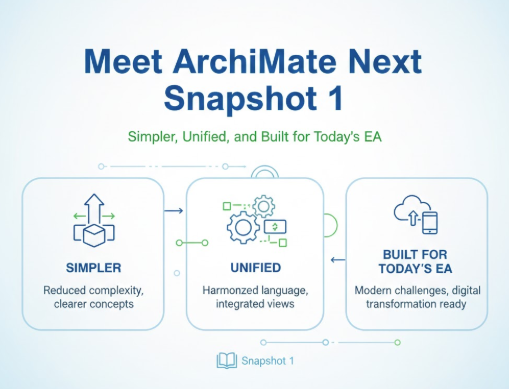
While not yet the final standard (expected as ArchiMate 4.0 after community feedback), this snapshot offers practitioners, tool vendors, and architects a glimpse into the future of EA modeling. With a strong emphasis on backward compatibility, conceptual unification, and visual clarity, ArchiMate Next promises to make enterprise architecture more accessible and practical than ever.
1. Simplicity First: Cutting the Clutter
One of the most striking changes in ArchiMate Next is its aggressive simplification of the metamodel. Over years, ArchiMate accumulated redundant concepts that added cognitive load without proportional benefit. Snapshot 1 removes several of these, streamlining the language for both new learners and seasoned architects.
🔹 Key Removals & Their Impact
| Element Removed | Why? | Replacement Strategy |
|---|---|---|
| Composition Relationship | Often confused with aggregation; rarely used meaningfully. | Use aggregation or assignment instead. |
| Interaction Elements (Business/Application/Technology Interaction) |
Redundant with collaboration and service behavior. | Replace with Collaboration or Service. |
| Constraint, Contract, Gap, Representation | Niche, overlapping, and underutilized. | Use Relationships, Events, or Annotations. |
💡 Example:
In ArchiMate 3.2, modeling a business process that involves an application interaction required two elements:Business ProcessandApplication Interaction.
In ArchiMate Next, this becomes a singleProcess(generic) connected via aCollaborationorServicerelationship—reducing diagram clutter and improving readability.
This shift makes models easier to understand at a glance, especially for stakeholders outside the EA team.
2. Unification: Breaking Down the Layers
The traditional layered matrix (Strategy → Business → Application → Technology) has long been a cornerstone of ArchiMate. But it often led to rigid, hierarchical thinking that didn’t reflect modern hybrid environments—especially those blending human, digital, and AI-driven components.
ArchiMate Next replaces the layer concept with “Domains”—a more modular, flexible approach that better reflects real-world enterprise complexity.
🔹 Unified Behavior Elements: One for All
All behavior types—Service, Process, Function, Event—are now unified under a single, domain-agnostic Behavior element.
✅ Before (ArchiMate 3.2):
Business Process
Application Service
Technology Event
✅ After (ArchiMate Next):
Process(applies across business, application, and technology)
Event(generic, no longer tied to implementation)
🎯 Example:
A customer onboarding workflow involving a human agent (business), a CRM system (application), and an AI-powered document validator (technology) can now be modeled as a single Process with Collaboration relationships to active structure elements across domains—no need to duplicate logic.
🔹 Generic Role: Flexibility Across Domains
The new Role is no longer limited to business contexts. It can now be assigned to any active structure element, whether human, software, or hardware.
✅ Example:
ACustomer Support Agent(business role) and aChatbot Service(technology role) can both be assigned the sameRoleofCustomer Inquiry Handler, enabling cross-domain collaboration modeling.
🔹 Unified Collaboration
All cross-layer interactions—business-to-application, application-to-technology, etc.—are now modeled using a single Collaboration element.
🎯 Example:
ALoan Approval Processinvolving aLoan Officer(business), aLoan Processing App(application), and aCredit Scoring Engine(technology) is now represented as oneCollaborationwith all three elements as participants—no need for separate interaction elements.
3. Visual Revolution: The Hexagonion Framework
One of the most visually striking innovations is the Hexagonion Framework—a new diagram structure replacing the classic rectangular layered matrix.
🌀 What Is the Hexagonion?
The Hexagonion is a hexagonal diagram that organizes the core architecture domains in a balanced, interconnected way. It reflects a more holistic, less hierarchical view of enterprise architecture.
🔹 Structure of the Hexagonion
| Section | Content |
|---|---|
| Top (Central Hexagon) | Core domains: Business, Application, Technology (merged into a single domain) |
| Top Left & Right | Strategy & Motivation (goals, drivers, requirements) |
| Bottom Left & Right | Implementation & Migration (projects, changes, transitions) |
| Center | Core building blocks: Active Structure, Behavior, Passive Structure |
🖼️ Visual Analogy: Think of a hexagonal hub with spokes connecting to strategic, operational, and transformational aspects—perfect for showing how decisions flow through the enterprise.
✅ Benefits of the Hexagonion
-
Reduces visual hierarchy—no more “top-down” bias.
-
Supports functional decomposition—ideal for modeling complex systems like DEMO transactions.
-
Improves readability—especially in large-scale or cross-domain models.
-
Aligns with modern EA patterns—such as value streams, digital twins, and AI integration.
🎯 Example:
When modeling a digital transformation initiative, the Hexagonion clearly shows how customer value goals (top) drive new processes (center), which are implemented via new applications and AI services (bottom), all linked through collaborations and events.
4. Metamodel Enhancements: Smarter, More Expressive Models
Beyond structure and visuals, ArchiMate Next introduces subtle but powerful upgrades to the underlying metamodel.
🔹 Cardinalities on Relationships
Now, relationships can specify cardinalities—e.g., 1-to-many, 0..1, 1..*—to define instance-level constraints directly in the model.
✅ Before: No way to express “one customer can have many accounts” without external documentation.
✅ After: Use aCompositionrelationship with cardinality1..*fromCustomertoAccount.
🎯 Example:
AServicecan now have a1-to-manyrelationship withProcesses, clearly indicating that one service may support multiple processes.
🔹 Path Element Revisions
-
Pathis now part of the Common Domain (shared across all layers). -
The relationship from Active Structure to
Pathis updated toRealization, reflecting that a service or process realizes a path or flow.
🎯 Example:
AData Flow Pathfrom a CRM to a BI tool is now aPathelement, realized by theData Export Service—making the model more semantically precise.
🔹 Standardized Colors & Viewpoints
-
RGB color codes are now standardized (e.g., Business =
#4A90E2, Technology =#50C878) to ensure consistency across tools and teams. -
Viewpoint mechanisms are enhanced with predefined templates (e.g., “Stakeholder Communication View”, “Migration Path View”) moved to appendices for better maintainability.
5. Backward Compatibility: Smooth Transition Planned
The Open Group has prioritized backward compatibility—a critical factor for enterprise adoption.
✅ Migration Path from ArchiMate 3.2
| Element in 3.2 | In ArchiMate Next | Migration Tip |
|---|---|---|
| Composition | Removed | Use Aggregation or Assignment |
| Business Interaction | Removed | Use Collaboration or Service |
| Gap | Removed | Use Event or Constraint annotation |
| Implementation Event | Replaced | Use generic Event |
| Layered Matrix | Replaced | Use Hexagonion framework |
🛠️ Tool Support: Major tools like Visual Paradigm Desktop are already testing support for the snapshot, with updates expected before the final release.
While custom scripts, reports, and viewpoints may require minor adjustments, the overall migration effort is expected to be minimal.
Community Perspectives: Excitement with Constructive Critique
Early feedback from the ArchiMate community has been largely positive, though not without nuance.
✅ Positive Reactions
-
Martijn Bakker (EA Consultant): “This is the simplification ArchiMate has needed for years. The Hexagonion is a game-changer for stakeholder communication.”
-
Zulfikar (Enterprise Architect, Financial Services): “Removing composition and interactions reduces noise. Now I can focus on what matters—value and flow.”
-
Bas van Gils (ArchiMate Forum Lead): “The unification of behaviors and roles makes hybrid human-AI models finally feasible.”
Conclusion: A Lighter, Smarter, More Inclusive ArchiMate
The ArchiMate Next Specification Snapshot 1 is more than a revision—it’s a reboot. By removing redundancy, unifying concepts, and introducing the Hexagonion, it addresses long-standing criticisms: too complex, too verbose, too rigid.
It’s designed for:
-
Newcomers who want to learn EA without drowning in terminology.
-
Practitioners who need faster, clearer communication with stakeholders.
-
Innovators building AI-augmented, hybrid, and real-time enterprise systems.
While not final, this snapshot signals a new era for ArchiMate—one that’s lighter, more inclusive, and deeply aligned with modern enterprise realities.
Get Involved Today
👉 Download the Snapshot:
publications.opengroup.org/s250
👉 Try It in Your Tool:
Test models in Visual Paradigm Desktop using the draft schema.
🌟 The future of enterprise architecture isn’t just about modeling complexity—it’s about modeling clarity. ArchiMate Next is leading the way.